
From Hotspots to Hotspaces: Cascaded Photonic-Plasmonic Coupling for SERS-based Deep Profiling of Whole Small Extracellular Vesicles
作者:Haoming Bao (鲍皓明), Emily Xi Tan, Jie Zhou, Xiang Zhao,* Sheng Yuan Leong, Chang Hoong Chek, Guo Kang Leon, Jaslyn Ru Ting Chen, Lam Bang Thanh Nguyen, Ling Li, Han Wei Hou, Hongwen Zhang, In Yee Phang, Xing Yi Ling
期刊:Science Advances
卷(期)页:aec1846
全文链接:https://www.science.org/doi/10.1126/sciadv.aec1846
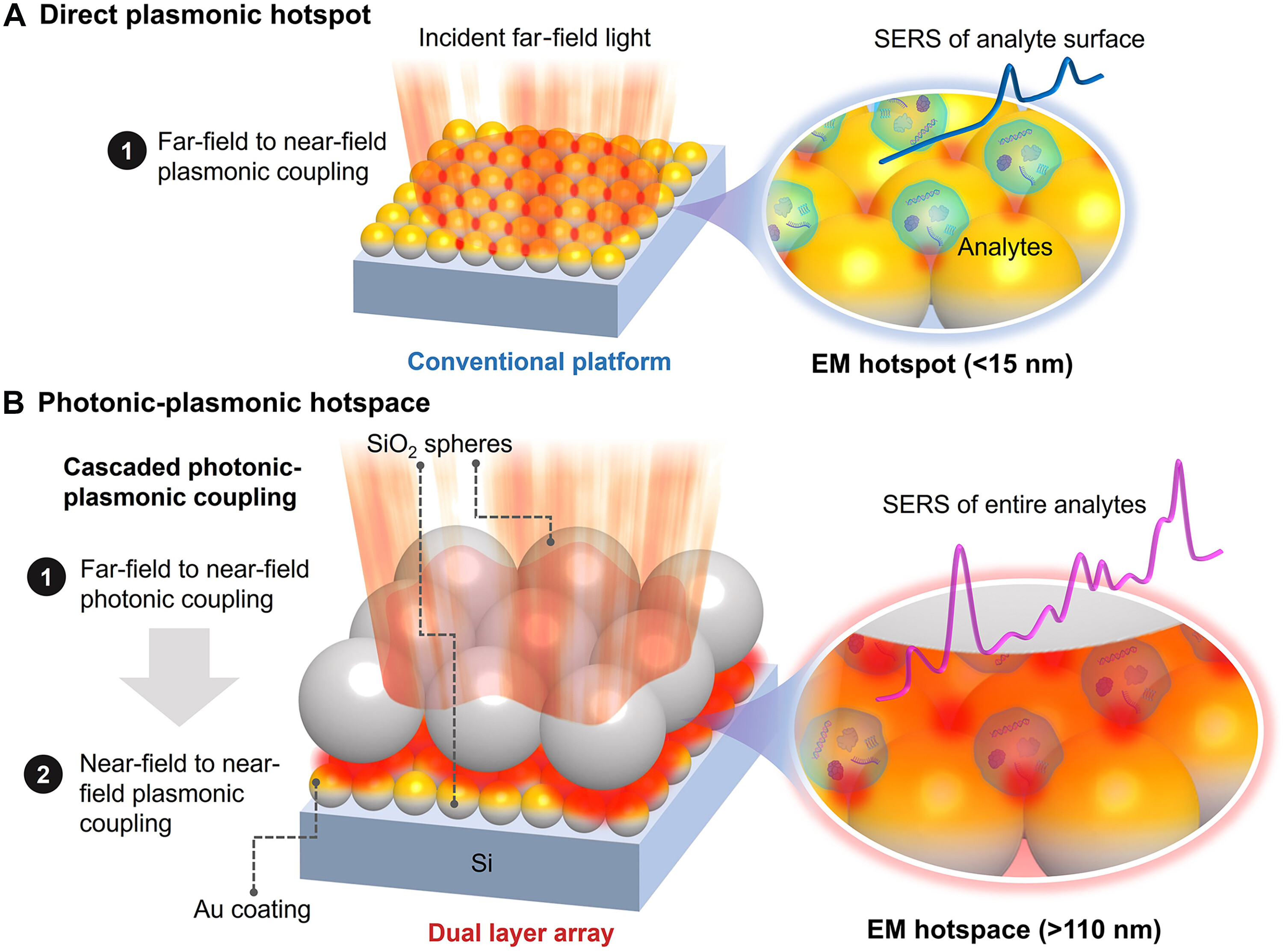
The spatial confinement of electromagnetic hotspots (<15 nanometers) in plasmonic nanostructures fundamentally restricts their utility for probing large, heterogeneous targets across diverse material and biological systems. We introduce a cascaded photonic-plasmonic strategy that bridges far-field illumination and near-field enhancement by integrating dielectric silicon dioxide microspheres that form subdiffraction nanojets on a plasmonic, gold-coated silicon dioxide nanoarray. This dual-layer architecture generates spatially extended electromagnetic “hotspaces” exceeding 110 nanometers in lateral extent and sustaining analytical enhancement factors > 106, a regime inaccessible to conventional surface-enhanced Raman scattering (SERS) platforms. In silico simulations and experiments reveal ~20-fold enhancements in signal intensity and spatial reach compared to conventional nanoarrays. As a proof of concept, we demonstrate ultrasensitive, label-free classification of extracellular vesicles, 80 to 200 nm in diameter, derived from patients with colorectal cancer with 99.8% accuracy, surpassing traditional SERS (<87.5%). More broadly, this cascaded excitation strategy shifts the emphasis from nanogap optimization to the engineering of spatially extended fields through hybrid light-focusing architectures, enabling advances in spectroscopy, biosensing, nanophotonics, and diagnostics.
期刊:Science Advances
卷(期)页:aec1846
全文链接:https://www.science.org/doi/10.1126/sciadv.aec1846
The spatial confinement of electromagnetic hotspots (<15 nanometers) in plasmonic nanostructures fundamentally restricts their utility for probing large, heterogeneous targets across diverse material and biological systems. We introduce a cascaded photonic-plasmonic strategy that bridges far-field illumination and near-field enhancement by integrating dielectric silicon dioxide microspheres that form subdiffraction nanojets on a plasmonic, gold-coated silicon dioxide nanoarray. This dual-layer architecture generates spatially extended electromagnetic “hotspaces” exceeding 110 nanometers in lateral extent and sustaining analytical enhancement factors > 106, a regime inaccessible to conventional surface-enhanced Raman scattering (SERS) platforms. In silico simulations and experiments reveal ~20-fold enhancements in signal intensity and spatial reach compared to conventional nanoarrays. As a proof of concept, we demonstrate ultrasensitive, label-free classification of extracellular vesicles, 80 to 200 nm in diameter, derived from patients with colorectal cancer with 99.8% accuracy, surpassing traditional SERS (<87.5%). More broadly, this cascaded excitation strategy shifts the emphasis from nanogap optimization to the engineering of spatially extended fields through hybrid light-focusing architectures, enabling advances in spectroscopy, biosensing, nanophotonics, and diagnostics.